Parrots are some of the most socially complex creatures on our planet. Like other highly intelligent animals, they place a lot of value on relationships with others of their kind and spend years building flocks with hierarchies. 90% of all bird species are monogamous and parrots are no exception - they bond for life. Social bonding is imperative in the life of a parrot. Their mate provides companionship as well as helps them groom, find food, and other duties necessary for survival and ensuring the continuation of their species. Breeding and rearing chicks is very important to parrots. Their need to mate and have offspring is very strong and unfortunately, cannot be met in captivity unless the breeding is encouraged by humans, which in most cases, it is not. When these social needs are not met, severe signs of stress can be seen in the behavior of the bird, like some of the examples seen on the previous page.
[ Interspecies Bonding ]
 A Goffin's Cockatoo and Mealy Amazon pair
 An Umbrella Cockatoo and a Jardine's Parrot pair
 A Sun Conure and Mitered Conure pair
Interspecies mated bonds have never been documented in the wild - most likely due to the fact that some of these birds are not closely enough related to produce an offspring. Karen Windsor, executive director of Foster Parrots, told me that all of these birds were given opportunities to bond with members of their own species. Instead, they were overwhelmingly attracted to another type of bird. Even though these birds vary in size, shape and personality, they get along just as well as two members of the same species.
[ Interspecies Mutilation and Overpreening ]
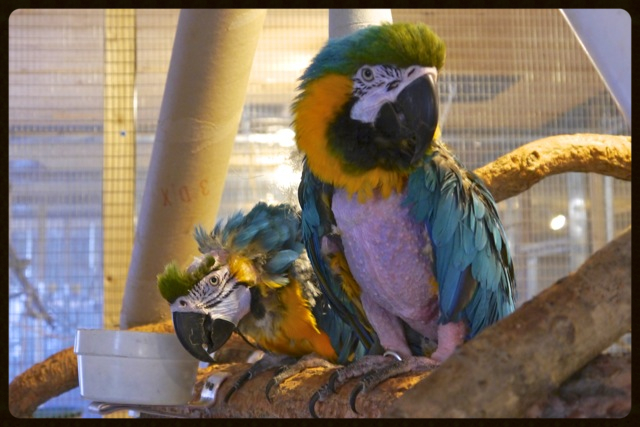
Charlotte and Captain are a mated pair of Blue and Gold Macaws. As you can see, Captain has a full head of feathers but his body and legs are bald. Captain has a habit of plucking feathers from Charlotte's body, including her head. I have noticed that the bird who takes the most damages seems to have no problem with this behavior and surprisingly tolerates it with no objection.
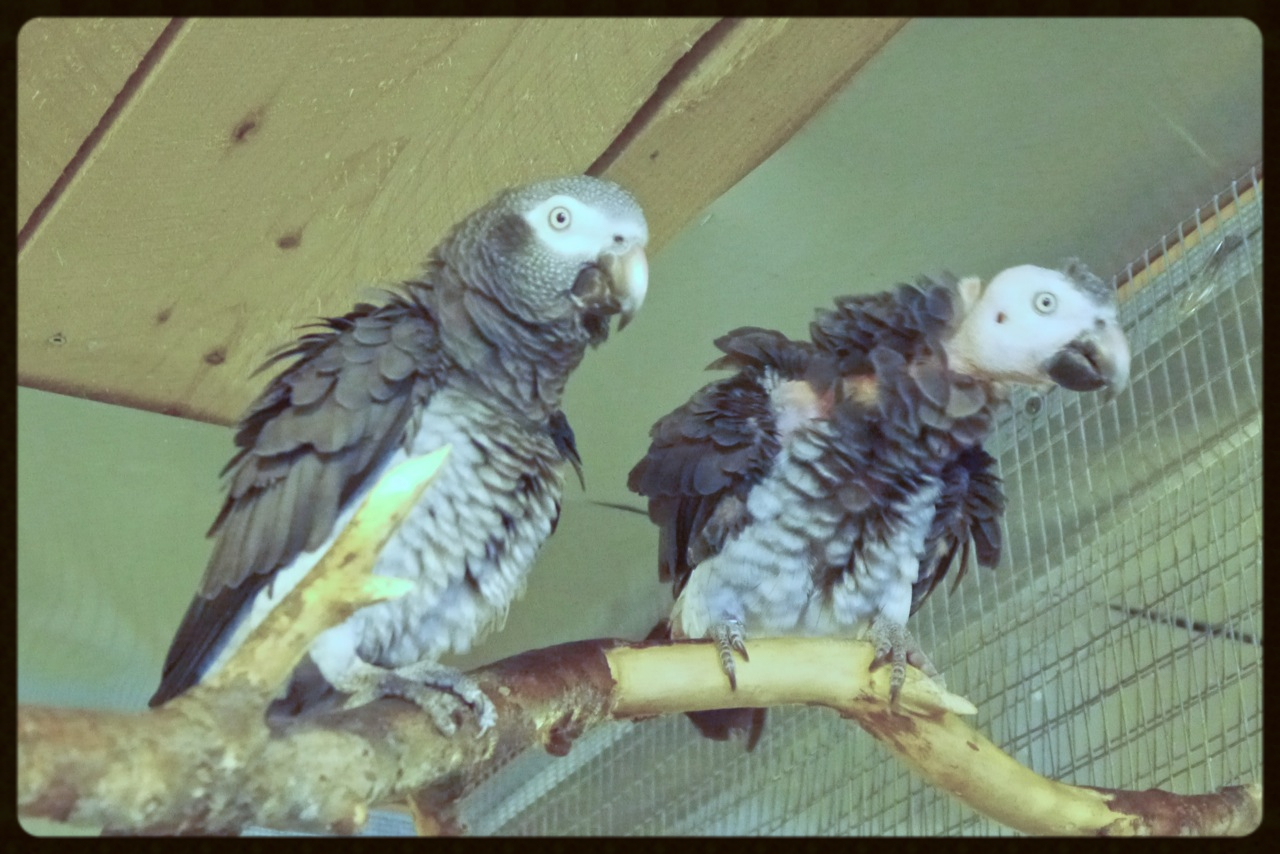
Marco and Polo, Timneh African Grey Parrots
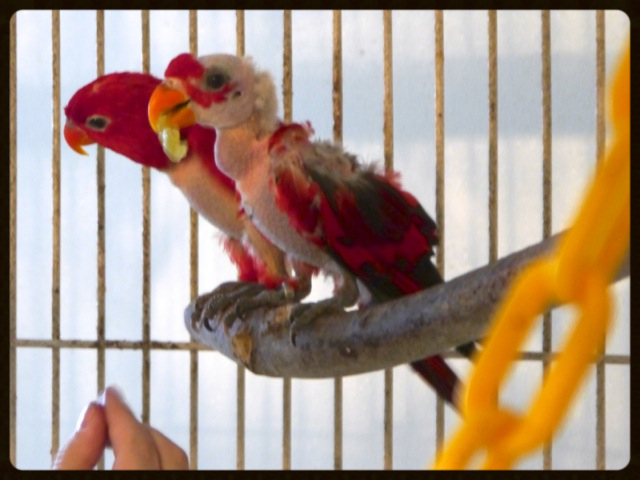
Pigeon and Newman, Red Lorikeets
If a pet parrot was raised in captivity, especially by a breeder, it runs the risk of being solely a human-bonded bird. This means it will not bond with any other birds and only seeks out social interaction with humans. Unfortunately, this is seen in some of the birds residing at Foster Parrots. Human-bonded birds often times don't realize they are a bird and they look at other birds as totally foreign. These birds will often times exhibit courting behaviors towards humans, including trying to regurgitate their food to feed their prospective human mate or go as far as to attempt mating with a human. This causes a lot of emotional stress for the bird because the bond and desire to mate is not reciprocated. As I mentioned before, the desire to mate and produce offspring is very strong in these animals and denying them that opportunity causes a lot of problems for them, including physical problems with their reproductive systems. Female birds will lay unfertilized eggs which depletes their body of calcium while male birds can have a genital prolapse from trying to mate too often.
There are plenty of birds at the sanctuary who exhibit none of the negative signs of stress I've covered in this collection. Many of them are well-adjusted and live with other birds of the same species, without any mutilation or stereotype behavior. This however, does not mean that their quality of life is anything in comparison to what it would be if they were free to live in the wild.
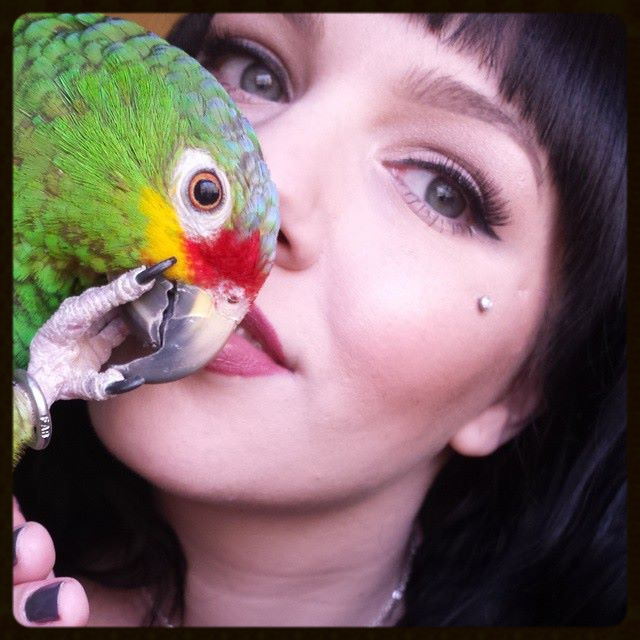
I have lived with this rescued Red-Lored Amazon parrot, Mango, for two years now. He was wild-caught in the 1980s and had been passed around several homes before finding his place with me. His previous guardians all reported behavior issues with Mango, saying that he was aggressive and too difficult to live with. I, on the other hand, find him to be extremely pleasant and gentle-natured. I provide him with a home that is safe and nurtures his natural instincts rather than trying to restrict them. He has changed my life in the most magical way possible and I am a better person because of him.
I want to thank all of the staff and volunteers at Foster Parrots, especially Michele, Brian and Karen, for their endless guidance and support throughout this internship. I can't wait to see what the future holds for us and all of our non-human friends.
