Jane Bates
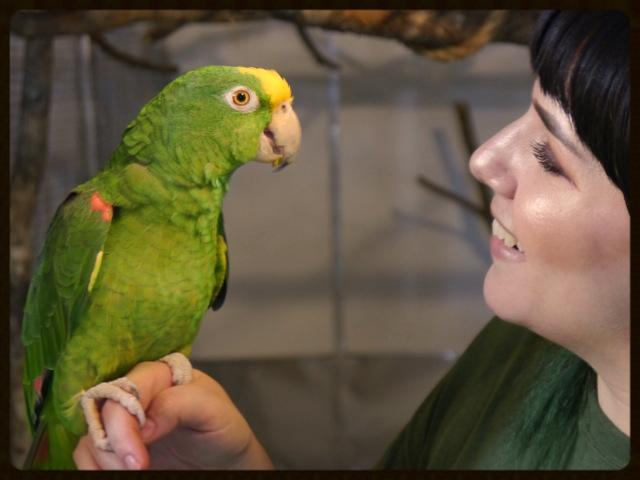
My closest feathered-friend at Foster Parrots, a Panama Amazon parrot named Twig
Hi there - my name is Jane Bates. I'm a psychology major (and biological sciences minor) at the University of Rhode Island. I'm thrilled to share with you a series of life changing experiences I was fortunate to have at Foster Parrots and the New England Exotic Wildlife Sanctuary, located in Hope Valley, Rhode Island. Foster Parrots was started by Marc Johnson and Karen Windsor with the goal to provide a place for misfortuned exotic animals to live peacefully. They spend a lot of time raising awareness about the negative affects of keeping these animals in captivity. Foster Parrots encourages its residents to act out natural behaviors and strives to provide an environment where the animals have as much freedom as possible.
My goal was to learn as much as possible about why captivity is dangerous to parrots and what happens when they are prohibited from thriving in their natural environment. A common misconception is that parrots are domesticated like the cats and dogs that live in our homes when in fact they are wild animals. Due to very specific social and psychological needs, parrots are very difficult to keep and often end up in shelters and sanctuaries.
With the support of the amazing staff at Foster Parrots and NEEWS, I will be continuing to spend time working with the birds as a volunteer following my role as an intern.
[ Internship Experience ]
In order to get close to the birds, my internship supervisor, Michele Parrett, thought it would be important for me to participate in the daily care chores that need to be done. My morning routine included giving baths to the birds, making sure their aviaries were clean, preparing meals specific to each bird's needs and most importantly, providing enrichment.
Enrichment varies depending on the individual bird. Foster Parrots is home to over 400 birds and each one of them has a completely different personality. Some of the birds don't like people (for various reasons) and some of them are completely human bonded, and unfortunately do not want to have relationships with other birds which makes it very difficult to house them with others of their kind.
Instead of keeping the birds in individual cages, the birds live in large aviaries which are separated mostly by species. This gives them more room to fly and act out behaviors that are natural to them. As we all know, it is not natural for birds to sit on a perch all day - it is in their nature to fly hundreds of miles per day and build nests and forage for food. It took a few weeks for most of the birds to become comfortable with me. You could see by their body language and facial expressions that they knew I was new to the group and it wasn't until I began offering treats and interacted with them confidently that they warmed up to me - some of the birds more than others.
Being involved in preparing and offering meals gave me the opportunity to go inside the aviaries and get up close to the birds. Some of them were eager to introduce themselves to me, some of them would vocalize and play, some would be hesitant and some would be aggressive. It is important to always remain calm with animals. I find that I am at ease with birds and it was important to me to respect their space. I was there to observe them, not to invade their space and cause them to act distressed. There were some cases of individual birds that really did not like me and were aggressive towards me. When working with these birds, another volunteer would take over so I avoided any potential danger.
Once the morning chores were done, the rest of my day was spent socializing with the birds. Standing by and watching them interact with each other, playing with them, offering food or treats to them, vocalizing with them, etc. A lot of the birds like music, so if I could, I would sing or whistle to them. Some of the human-bonded birds become lonely and it was important to me to provide them with social stimulation. I would talk to them, tell them stories or read to them. Giving them an opportunity to be social and vocalize made a noticeable change in their demeanor. They would perk up and become eager for more and more enrichment.
The more time I spent immersed in the aviaries, the more I noticed some odd behaviors and situations. This caused me to ask a lot of questions to the staff, and I was directed to a lot of great references. Unfortunately, we don't know enough about parrot psychology to explain the exact reasons for these behaviors but we can use what we do know to begin to try to help them.
Please use the links at the top of the page to discover some of the common problems seen in parrots that are kept in captivity.
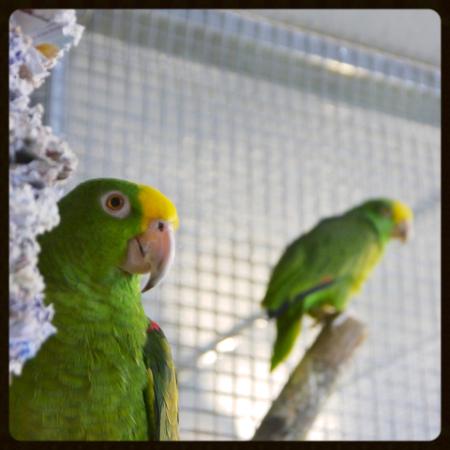
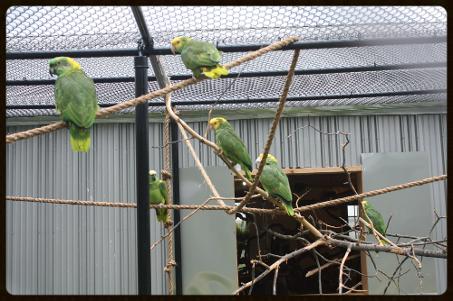
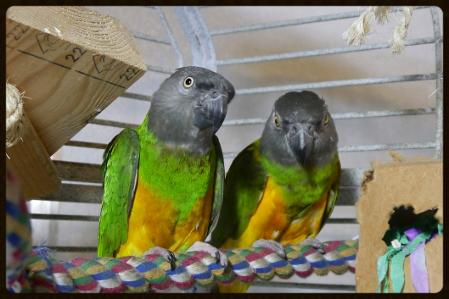
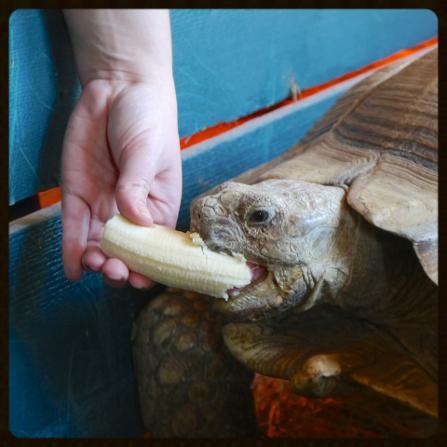
All photos used in this presentation have been provided by Karen Windsor and sanctuary photographer, Brian Jones
